These games, STEM experiments, activities, memory verse activities, and worship response ideas are easy to prep and do in your children’s ministry with kids of any age. These activities are great for Sunday school, children’s church, or midweek! For more details and engaging lessons to help kids grow in their faith, check out Wonder Ink curriculum.
Children’s Ministry Activities
1. Game: Animal Mashup
In this game, the leader will call out two types of animals. Half of the group will act like the first animal and sound like the second while the other half of the group tries not to laugh.
Tip: Try this idea for dividing into two teams: 1. Cut two colors of paper into slips (1 per kid), and put an equal number of each color in a basket. 2. Each kid reaches in and pulls out a slip with his eyes closed. 3. Kids gather with everyone with the same color slip.
Gather kids and help them divide into two teams. Invite teams to stand on opposite sides of the room facing each other. Name one team “Team A” and the other “Team B.” Explain that you’ll call out two types of animals, and everyone on Team A will act like the first animal while making the sound of the second animal. If you’re physically able, demonstrate by galloping like a horse while meowing like a cat, or invite another leader to demonstrate. Team B will watch Team A and try not to laugh. Anyone who laughs must do five jumping jacks at the end of the round (or another simple action such as jumping up and down). Then teams will swap roles, with Team B acting and sounding like two different animals while Team A tries not to laugh.
Tip: For Younger Kids. Acting like one animal while sounding like another might be too challenging for younger kids as well as for kids with learning challenges. As needed, invite kids to choose either of the animals to act and sound like.
Play several rounds and give both teams equal opportunities to act and watch without laughing. Here’s a list of animals to get you started: dog, elephant, pig, fish, cow, chicken, horse, donkey, duck, mouse, cat.
Gather kids back together. Great job mashing up those animals and trying not to laugh. Sometimes when we see or hear something so funny or unbelievable, it’s hard not to laugh! That might be how Sarah felt when God told her she was going to have a baby and she was too old to have babies. The Bible tells us Sarah laughed when she heard she was going to have a baby at her age. But sure enough, God kept His promise, and she gave birth to Isaac. Because God keeps His promises!
2. Game: Name Drop
SUPPLIES: large flat bedsheet, chairs or stepstools (2, optional)
In this game, two kids will face each other with a sheet between them. After counting to three, the sheet will drop, and the two kids will see who can say the other’s name first.
Gather kids and invite everyone to take turns introducing themselves. Encourage kids to listen carefully to each person’s name because they may need to remember it for this game!
Next, divide the group into two teams, and have each team sit on opposite sides of the room. Ask two leaders to hold up a large flat bed sheet between the teams. If needed, have the leaders stand on chairs or stepstools. The sheet should completely block kids’ view of the other team. Invite one kid from each team to face each other with the sheet between them so they cannot see each other. Do not say their names out loud. Explain that after you count to three, the leaders will drop the sheet. The two kids standing will try to say each other’s names as quickly as possible. Whoever says the other person’s name first wins! The winner will remain standing as the sheet goes back up, and the leader will choose a new opponent to compete.
Tip: For Younger Kids. Lessen the pressure of the game by having two kids from each team stand on each side of the sheet. When the sheet drops, each pair can work together to remember the names of both people facing them.
Play multiple rounds as time allows. Then gather kids back together. Wow! Good job remembering each other’s names! Names are important, and when God looks at each of us, He sees who we truly are—chosen and beloved—and He calls us by name!
3. Interactive Activity for Children’s Ministry: The Nearly Impossible Challenge
Gather kids together. Today let’s play The Nearly Impossible Challenge. Together we’ll attempt some impossible—or nearly impossible—challenges. Our goal isn’t to do them all perfectly but to have fun trying, so remember to laugh!
Tell the kids the next challenge: Touch your tongue to your nose. Try doing the challenge and encourage kids to try as well! If anyone can do it, invite them to the front to show everyone. Advance through all eight challenge slides, trying each yourself if you’re physically able and encourage kids to try as well. Remember to laugh a lot as everyone attempts these silly feats! Here is a list of the eight challenges for your reference:
1. Touch your tongue to your nose.
2. With one hand, tap the top of your head. Continue to tap your head as you rub your belly in a circular motion using the other hand.
3. Raise one eyebrow.
4. Wiggle your ears (without touching them).
5. Lick your elbow.
6. Curl your tongue.
7. Hold both feet and jump over an imaginary line on the floor.
8. Sit on the floor with both legs stretched out in front of you. Then stand up without using your hands.
Wow, those challenges were difficult! In fact, some of them were not possible for most humans. A ton of practice time still wouldn’t make those challenges possible. The only option is to laugh at ourselves!
While some things are impossible for people, nothing is too hard for God. That means that when God makes a promise that seems impossible, we know He will keep it!

4. Memory Verse Activity
SUPPLIES: Bible, beanbags or tennis balls (1 per small group)
We can remember that God kept His promise to Abraham and keeps all His promises! Let’s praise God by saying our memory verse. Open your Bible to Psalm 90:2. Then read Psalm 90:2 several times together.
Now let’s practice our memory verse by playing a fun game. Gather kids in a circle. Then explain that when the beanbag (or tennis ball) is tossed to them, it will be their turn to say the Bible verse. Ask kids to say as much of the verse as they can remember, but when they get stuck, they can pass the beanbag to a friend. Keep tossing the beanbag until every kid has had a chance to say the memory verse. Reassure kids that it’s OK if they can only remember one or two words in the verse before passing the beanbag. The idea is to have fun repeating God’s Word and to work as a team! For extra fun, suggest kids do silly challenges while saying the verse, such as jumping up and down, standing on one foot, or speaking in a funny voice.
5. Worship Response: Promise Bags
SUPPLIES: Bibles (1 per kid), paper lunch bags (1 per kid), coloring utensils, note cards (5–6 per kid), assortment of stickers (optional)
Gather kids in a circle. There’s a story in the Bible about a time when God made a promise to Abraham and Sarah. God promised a big family—as numerous as the stars in the sky. God gave the promise of a family many years before Sarah gave birth to Isaac.
- Do you think that Abraham and Sarah ever felt sad, discouraged, or like God had forgotten about them while they were waiting on God’s promise to be fulfilled? Explain.
- What do you think Sarah and Abraham might have done to stay encouraged and not give up on God’s promise?
Give each kid a paper bag. At the center of the circle (or in the front of the room if kids aren’t in a circle), place coloring utensils and stickers, if available. Let’s make Promise Bags to help us remember that God keeps His promises. To start, let’s write our names on the back of our paper bags and then decorate our bags with designs and pictures that remind us that God loves us and is always faithful. Encourage kids to have fun while decorating and to talk with each other about promises God made in the Bible and in their lives. Play worship music as kids work.
After a couple minutes, invite kids to hold up their bags. Wow, what beautiful bags! Now let’s write or draw pictures and words to put in our bags that will help us remember God always keeps His promises. Give each kid 5–6 note cards or set a pile of cards in the center of the circle (or front of the room) along with Bibles. Invite kids to think about promises God has already answered in their lives or in the lives of people in the Bible. On each note card, they can draw or write a promise from God, a praise to God, a scene or person from a Bible story, or a Bible verse. Invite three kids to each read one of the verses aloud for the group. Kids can copy any or all of those verses onto their cards or choose other favorite verses from the Bible. Again, play music as kids work.
After several minutes, encourage kids to place their note cards into their Promise Bags. Let’s take our Promise Bags home and set them somewhere we will see often. Then next time you are worried or upset, reach into your Promise Bag and pull out the pictures and encouraging words inside. Let them remind you of what God has already done and build your faith in what He is going to do. God always keeps His promises!
6. STEM Experiment: Bubble Shapes
SUPPLIES: bubble solution, bubble wand, various small cookie cutters, shallow dish or container
Gather the container of bubble solution, bubble wand, and a variety of small cookie cutters and a shallow dish. Pour the bubble solution into the shallow dish or container.
Invite the kids to gather around while you blow bubbles.
What shape are the bubbles? Allow time for responses. They’re round! All of them are round! Do you think the bubbles will still be round if we use a different shaped bubble blower with this cookie cutter? Allow the kids to respond. Dip one of the cookie cutters into a shallow dish filled with bubble solution and blow through the cookie cutter.
Did you see that? The bubbles are still round! Let’s try another shape! Dip another shaped cookie cutter into the solution and blow. The bubbles are still round! Try as many shapes as you would like, if the kids are interested and time allows. No matter what shape the bubble blower is, the bubbles are always round! We can count on bubbles to be round. We can also count on God to be faithful because He always is! Even when things around us change, God does not change. God is faithful! We’ll learn more about that in God’s big story today.
7. STEM Experiment: Impossible Bubbles
SUPPLIES: bowl; spoon; Impossible Bubble solution ingredients: warm water (distilled if possible, 2 cups), sugar (2 Tbsp.), blue liquid dish soap (4 Tbsp.); store-bought bubble solution and wand; spray bottle filled with water; plastic wrap (prep only); disposable straws (up to 1 per kid); table or other flat surface; towels, How-to Impossible Bubbles STEM Video (prep only, optional)
Ahead of time, make the Impossible Bubble solution for this experiment by adding two tablespoons of sugar to two cups of warm water (distilled water works best) in a bowl and mix with a spoon until the sugar is dissolved. Then add four tablespoons of blue liquid dish soap to the solution. Mix gently to avoid creating bubbles or foam. Cover the solution with plastic wrap and allow it to sit at room temperature for a few hours (overnight is optimal). Consider watching the How-to Impossible Bubbles STEM Video for a demonstration of the activity.
Gather kids together. Have you ever blown bubbles? Invite kids to respond; then blow a few bubbles using the regular bubble solution and wand. What do you think is the biggest bubble you’ve ever blown? Invite kids to use gestures to show their answers; then blow a few more bubbles. Bubbles are pretty amazing! But there are probably some things that bubbles can’t do! Do you think it’s possible to blow a bubble as big as a skyscraper? Pause for kids to answer. Do you think it’s possible to blow a bubble so tiny that you can only see it in a microscope? Pause for kids to answer. Do you think it’s possible to blow a bubble within another bubble? Pause for kids to answer. It sounds pretty impossible, but let’s find out!
Demonstrate the following steps for kids as they gather around to watch. (If your group and space are large, consider preparing multiple stations with a set of supplies at each. Assign kids to each station, and invite a different leader to demonstrate the experiment at each station.)
- Spray the table or flat surface with a thin layer of water.
- Dip one end of a straw into the bowl of bubble solution.
- Set the wet end of the straw directly onto the table and blow into the other end. A dome-shaped bubble should form. Stop blowing and gently remove straw from bubble.
- Dip one end of the straw back into the bowl of bubble solution.
- Gently insert the wet end of the straw into the dome-shaped bubble so that it is inside the bubble but above the table’s surface. Blow into the other end of the straw. A new, smaller dome-shaped bubble should form within the original one.
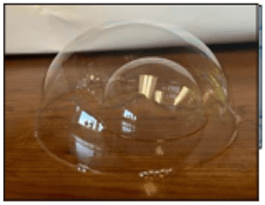
Once they’ve seen you blow a bubble within a bubble, consider giving a clean straw to each kid and giving kids a chance to try. (Coach them not to suck their straws so hard that the bubble solution reaches their mouths.) For added challenge, see if anyone can blow a bubble within a bubble within another bubble!
In this activity, we did something that had sounded almost impossible—we blew a bubble within a bubble! Do you know what made this possible? Pause for answers. It was actually the water we sprayed on the table ahead of time that made this experiment possible. God is the One who can do anything—even things that seem impossible! God is powerful!
8. STEM Children’s Ministry Activity: Move That Ice!
SUPPLIES: twine, scissors (prep only), bowl of ice cubes, table, table salt (1 or more shakers)
Ahead of time, decide if you will provide materials and space for kids to pair up and do the experiment themselves or if you will demonstrate it while the kids watch. Plan what works best for your space and group! Cut twine into 6″ lengths, one for everyone doing the experiment. Also test the experiment ahead of time so you know what to expect. Set up a table at the front of the room, and just before the activity begins, set a bowl of ice cubes on the table. Keep the ice cubes in a freezer or cooler until the activity begins.
Gather kids together. Hold up an ice cube and ask: What do you know about ice? Allow kids to share. Wow! You are quite the ice experts! But do you think it’s possible to move this ice cube (hold up an ice cube) without touching it (set the ice cube on a table in front of you)? How? Invite kids to share their ideas. Those are great ideas! But let’s see if you can figure out how to move an ice cube using only a piece of twine and some salt.
If you have the space and supplies for all the kids to do the experiment with a partner, hand one ice cube and a 6″ piece of twine to each pair of kids, and set out salt shakers where everyone can access them. Invite kids to see if they can figure out a way to move their ice cubes using only the materials provided. Kids may or may not figure it out—either is OK! After a couple minutes, demonstrate the experiment and invite kids to try it too.
If demonstrating the experiment while kids watch, invite them to share their ideas: How do you think we can move the ice without touching it? Try out each idea as they share it. Then show them how to do the experiment.
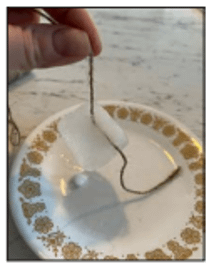
Move That Ice! STEM Experiment:
1. Set a piece of twine on top of an ice cube.
2. Sprinkle a good amount of salt on top of the ice and twine.
3. Wait several seconds (up to a minute, if needed). The salt should cause the top of the ice cube to melt.
4. Pick up the two ends of the twine and lift them into the air, which should lift the ice cube.
Explain the science behind the experiment: Salt lowers the freezing point of water, so when it’s sprinkled on ice, it causes the ice to melt. (This is why salt is sometimes spread on icy winter roads.) In our experiment, salt melted the top of the ice cube which then refroze around the twine.
In this activity, we did something that had sounded almost impossible—we made the ice move without touching it! And it was the salt that made this possible. God is the One who can do anything—even things that seem impossible! God is powerful!
9. Craft: Paper Cup Telephones
SUPPLIES: paper or plastic disposable cups (2 per kid), thumbtack, scissors (prep only), paper clips (2 per kid), yarn or string (at least 4′ per kid), stapler, markers (optional), paint (optional), stickers (optional)
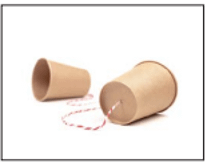
Before the kids arrive, prepare two paper or plastic disposable cups per kid. Use a thumbtack to poke a hole in the bottom of each cup. Cut a piece of yarn or string long enough for each kid to have at least four feet.
There’s a story in the Bible about when God spoke to Samuel. At first, Samuel didn’t recognize that it was God speaking, but after three times, Samuel said, “Speak. I’m listening” (1 Samuel 3:10). We can listen for God too. Let’s make a paper cup telephone to help us remember to listen to God.
Give each kid two cups and a piece of yarn or string. Help them put the string through the holes in their cups and tie it in a knot with a paper clip on the end. They will put the string through the cup hole in one cup and then put the other end in the other cup. The paper clips should keep the string secure.
To make it more fun for kids, you can allow them to decorate their cups using markers, paint, or stickers.
When the kids finish making their paper cup telephones, show them how to use them by allowing one person to hold one cup and another person to hold the cup on the other end of the piece of yarn, while they pull the yarn so it’s tight. Then one will take a turn saying something into one cup while the other person listens to the cup on the other end of the yarn.
Let’s take turns speaking and listening as we share God’s messages with one another! Find a partner and use your paper cup telephones. Take turns telling each other one thing about our story today that stood out to you or one message from God that you’ve heard from the Bible. When you finish, share whether it was harder to speak or to listen. Allow the kids to use their paper cup telephones to talk and listen to one another.
Take your telephone home as a reminder that we can always listen for God!
10. Worship Response Children’s Ministry Activities: Anointing Oil
SUPPLIES: clear jar or bowl, water, medicine dropper/syringe or spoon, cooking oil (1 cup), table, food coloring (optional), writing and coloring utensils (optional), paper or notebooks (optional)
Ahead of time, pour water into a clear jar or bowl so that it is about ⅔ full. (During the activity, you’ll pour one cup of oil into the water, so make sure there is space in the jar or bowl for the oil.) Consider dyeing the water with food coloring for a fun effect. Measure out one cup of cooking oil (such as olive or canola oil). Place a table at the front of your teaching area and on it set the jar or bowl of water, a medicine dropper/syringe or spoon, and one cup of cooking oil.
Tip: If anointing with oil is something your church practices, consider anointing each preteen with oil during this worship response time. You might invite a pastor, church leader, or kids’ parents in to anoint kids and remind them that they are loved, chosen, and set apart by God.
There’s a story in the Bible about a time when Samuel used oil to anoint David as the new king of Israel. Anointing is a spiritual act in which someone pours oil over the head of someone else to symbolize that person being set apart by God for a special purpose or job. David was set apart by God for the special job of being king of Israel. When Samuel anointed David, David wasn’t yet a soldier or a hero. David was just a regular shepherd boy who was chosen by God for a special job.
You are special to God too. God loves you. He sees your heart and has a special plan for you. We’re going to pour oil into water and watch how it reacts. As we watch, I invite you to spend time talking with God in prayer. Ask Him to help you remember how He sees you and ask Him to help you look at other people’s hearts just as He does. Quietly play worship music as you use a medicine dropper/syringe or a spoon to drop oil into the water. Consider inviting kids to take turns dropping in the oil. As kids watch the reaction of the oil and water, encourage them to talk with God. Point out that just as the oil floats to the top of the water, our prayers rise to the ears of God, who loves us and always hears our prayers. Consider having paper or notebooks and writing and coloring utensils available for kids to journal or draw their prayers.
Tip: Provide small notebooks for preteens to use every week as prayer journals. Invite them to decorate the covers; then keep them in your space for kids to use each week.
After a few minutes of prayer, close this response time by praying together: God, thank You for seeing us, knowing us, and choosing us. Help us remember that You see our hearts and help us open our whole hearts to You. Help us love and see others the way you do. We love You. In Jesus’ name, Amen.
Check Out These Helpful Resources!
Curriculum Resources
- Children’s Ministry Leaders Share Why They Love Wonder Ink
- Top 10 Reasons to Try Wonder Ink Children’s Curriculum for Free
- 5 Things that Make a Great Children’s Curriculum
- Why You Need to Make Sure You’re Using a Bible-Based Children’s Curriculum
- Wonder Ink Orientation
- Children’s Church Lessons: An Overview + Free Samples
Teaching and Leading Children
- Known, Loved, and Led: Helping Children Know Who They Were Created to Be
- Bringing the Bible to Life in Your Children’s Ministry
- What If We’re Failing Kids at Faith Formation? And How Not To
- Moving Beyond the Behavior: Getting to the Heart in Your Children’s Ministry